

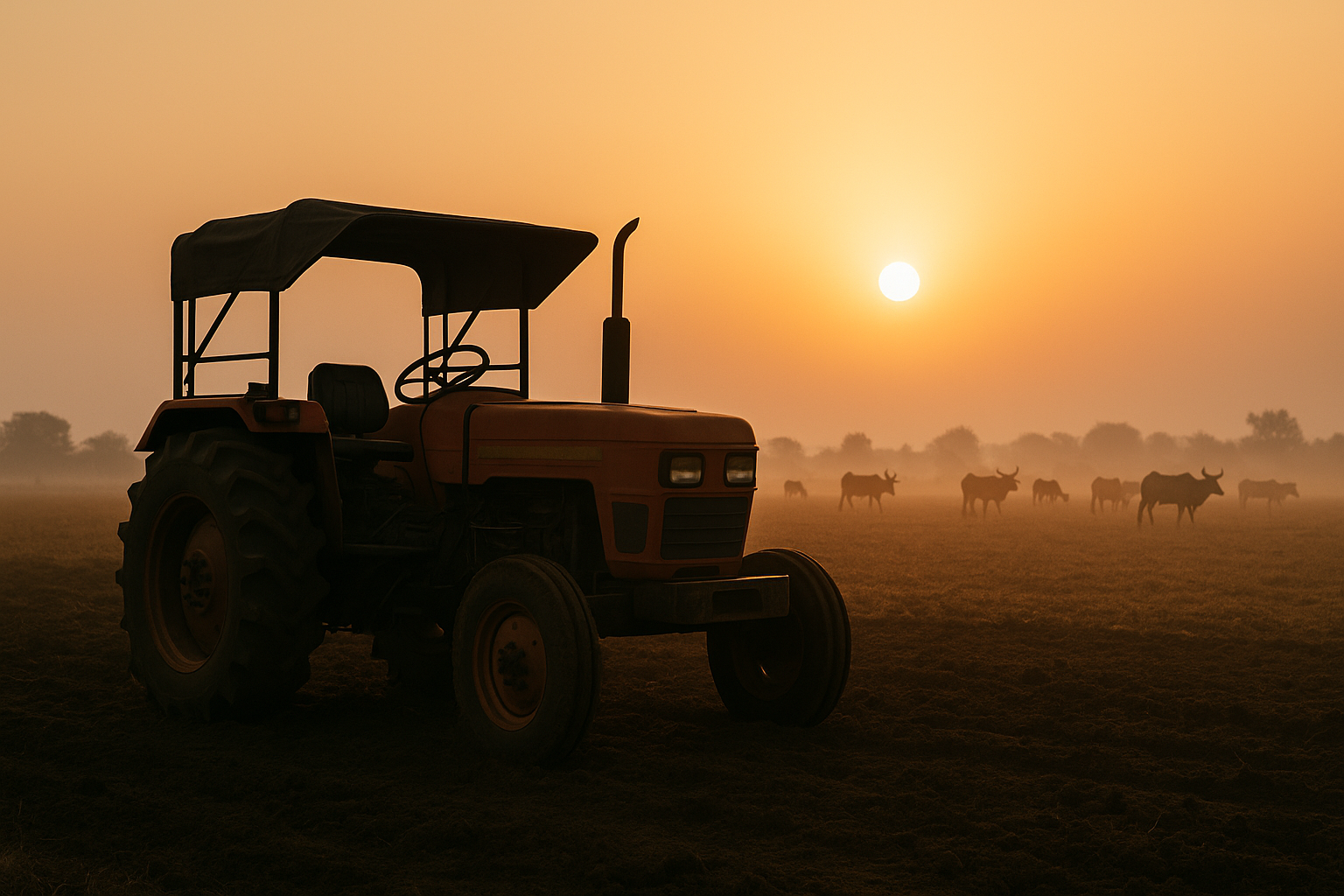
“The rental economy did not start in boardrooms. It started with common sense, shared necessity, and trust.”
When Labor Shortages Forced a New Farming Reality
I still remember the moment things changed at home.
One day, my father asked a close friend if he could help find someone to look after our cattle. It was the first time he openly admitted that managing them had become difficult. Labor was scarce, responsibilities were growing, and routines that had once felt natural were becoming harder to sustain.
What felt like a personal family challenge was part of a much larger transition happening across rural India.
Rural-to-urban migration was accelerating. Young men were moving to cities in search of better opportunities, leaving behind farms that had always depended on shared hands and seasonal labor. Fields grew quieter, not because the work was finished, but because the workforce had changed.
Between 2001 and 2011, more than 37 million people migrated from villages to cities, according to Census of India data — one of the most significant internal movements in India’s history. This shift quietly redefined the social and economic fabric of rural communities, leaving ageing families and fewer hands to manage livestock and fields.
Across many states, collective routines that once relied on neighbourly cooperation began to thin out. Shared labour evolved into scheduled work, and the quiet rhythm of village interdependence gave way to a new logic of efficiency and resource sharing — a behaviour that would later echo in the rise of the modern rental economy.
Without realizing it, these villages were laying the groundwork for what would later become the modern rental economy.
From Dependence to Efficiency
For generations, cattle shaped the rhythm of agricultural life. They powered ploughs, hauled harvests, and supported entire households. They were dependable, relatively affordable, and essential — especially in regions where dairy income was a key part of family finances.
But as labour shortages grew, timely fieldwork became harder to guarantee.
Delayed ploughing and late sowing don’t just disrupt schedules; they reduce yields and increase financial risk. Mechanization shifted from being a convenience to becoming a necessity.
The arrival of the first tractor in our village made that reality visible. Across India, the same story was unfolding: tractor numbers rose from barely 30,000 in the early 1960s to more than 2 million by the early 2000s, according to FAO- and World Bank–linked mechanization data compiled by Helgi Library. This reflected a shift from animal power to machine precision across rural landscapes. A task that once took several days with cattle could now be completed in hours.
Traditional practices continued, but the timelines of farming had changed. The tools needed to keep up had changed too.
The Economic Logic: When Idle Assets Found New Purpose
Buying a tractor was not a casual decision. Families saved for years, often pooling resources, to afford one. Once the land-preparation season was over, however, the machine often sat idle.
And in a village, idle machinery never goes unnoticed.
Neighbors began asking to borrow it. At first, it was a favor. Then some offered to pay for a few hours. Gradually, those occasional requests turned into scheduled usage. What started as informal sharing evolved into a structured pattern:
- Borrowing turned into small payments
- Payments turned into predictable income
- One tractor quietly began serving many farms
This behavior aligns with global findings. The World Bank has noted that shared equipment and service-based mechanization can significantly improve productivity in small-farm regions, reducing bottlenecks and helping farmers complete time-sensitive tasks on schedule.
Our village had adopted this logic long before the studies were written.
Micro-Enterprise: When Shared Machinery Became a Business Model
This informal network of shared usage became an early prototype of the equipment rental economy.
The benefits looked remarkably similar to the logic that powers modern rental businesses today:
- Asset recovery: Owners could recover their investment faster
- Accessibility: Smaller farmers accessed machinery without large upfront costs
- Income generation: Idle machines earned money during downtime
- Operational timeliness: Work stayed on schedule despite labor shortages
As this simple system proved its value, it expanded.
Tillers, sprayers, water pumps, harvesting tools, small construction equipment, and transport vehicles all started to circulate in a similar way. For communities constrained by capital but rich in ingenuity, one principle became clear:
Buy what you use frequently. Rent what you need occasionally.
This system grew organically. There were no formal policies, frameworks, or platforms. Just trust, necessity, and common sense.
A Rural Shift That Mirrors a Global Trend
What happened in that village was not unique — it was an early expression of a global pattern.
Across agriculture, construction, logistics, events, and commercial equipment, businesses are shifting from pure ownership to smart access. Instead of tying up capital in assets that sit idle, they are turning to rental models to improve utilization and reduce risk.
According to Grand View Research, the global construction equipment rental market is projected to reach USD 280 billion by 2030, driven by an increased focus on utilization, flexibility, and cost efficiency.
The underlying logic is the same everywhere:
- Ownership locks up capital
- Idle assets add upkeep costs
- Access keeps work moving
- Shared use multiplies value
Looking back, the changes in our village were quiet but transformative:
- Cattle were freed from the hardest labour
- Farmers accessed modern tools without falling into debt
- Machines stayed useful through shared use
- Villages found efficiency and value long before “rental” became an industry
“The rental economy did not start in boardrooms. It started with common sense, shared necessity and trust.”
The roots of today’s rental industry can be traced back to these early moments — when families realized that tools hold greater value when they move, when they serve, and when they support many instead of one.
This practical wisdom shaped the foundation of a global rental mindset.
A Timeless Insight for Modern Businesses
The principles that emerged naturally in rural communities continue to guide today’s asset-heavy industries.
Whether in agriculture, construction, events, manufacturing, tools, or small business operations, the core idea remains the same: tools become more valuable when they are shared, utilized, and accessible at the right time and place.
The rental economy is simply that village wisdom, scaled and structured.
This is the mindset that platforms like Rentablez help organise today — turning timeless rental wisdom into structured, scalable systems.
The principle hasn’t changed; only the tools have. What once ran on trust and proximity now runs on platforms and precision.
From fields to fleets, from villages to cities, one truth endures:
Assets create the most value when they are in use — active, accessible, and earning.